Asbestos discovered mid-renovation? Here's what the abatement process actually involves — and how to avoid the delays, costs, and contractor confusion that trip most homeowners up.
You pulled up a floor tile. Or your demo crew found something wrapped around the pipes. Or your inspector flagged a popcorn ceiling and now your closing timeline is in jeopardy. Whatever brought you here, you’re probably looking for the same thing: a clear answer about what happens next.
Asbestos abatement isn’t complicated once someone explains it plainly. But most contractors either bury you in technical language or skip straight to a quote without telling you anything useful. We’re going to do neither. Here’s what asbestos abatement contractors actually do, what it costs in Montgomery County, and what separates a contractor worth hiring from one you’ll regret calling.
Before anyone removes anything, you need to know what you’re actually dealing with. An asbestos inspection involves collecting samples of suspected materials — floor tile, ceiling texture, pipe insulation, joint compound, mastic adhesive — and sending them to a certified lab. You can’t identify asbestos by looking at it. The fibers are invisible to the naked eye, which is exactly what makes them dangerous.
In Pennsylvania, if the amount of friable asbestos material being disturbed exceeds 3 square feet or 3 linear feet, the project requires advance notification to the PA Department of Environmental Protection — at least five days before work begins. That’s a state-specific rule most homeowners in Montgomery County don’t know about until they’re already mid-project and in violation of it.
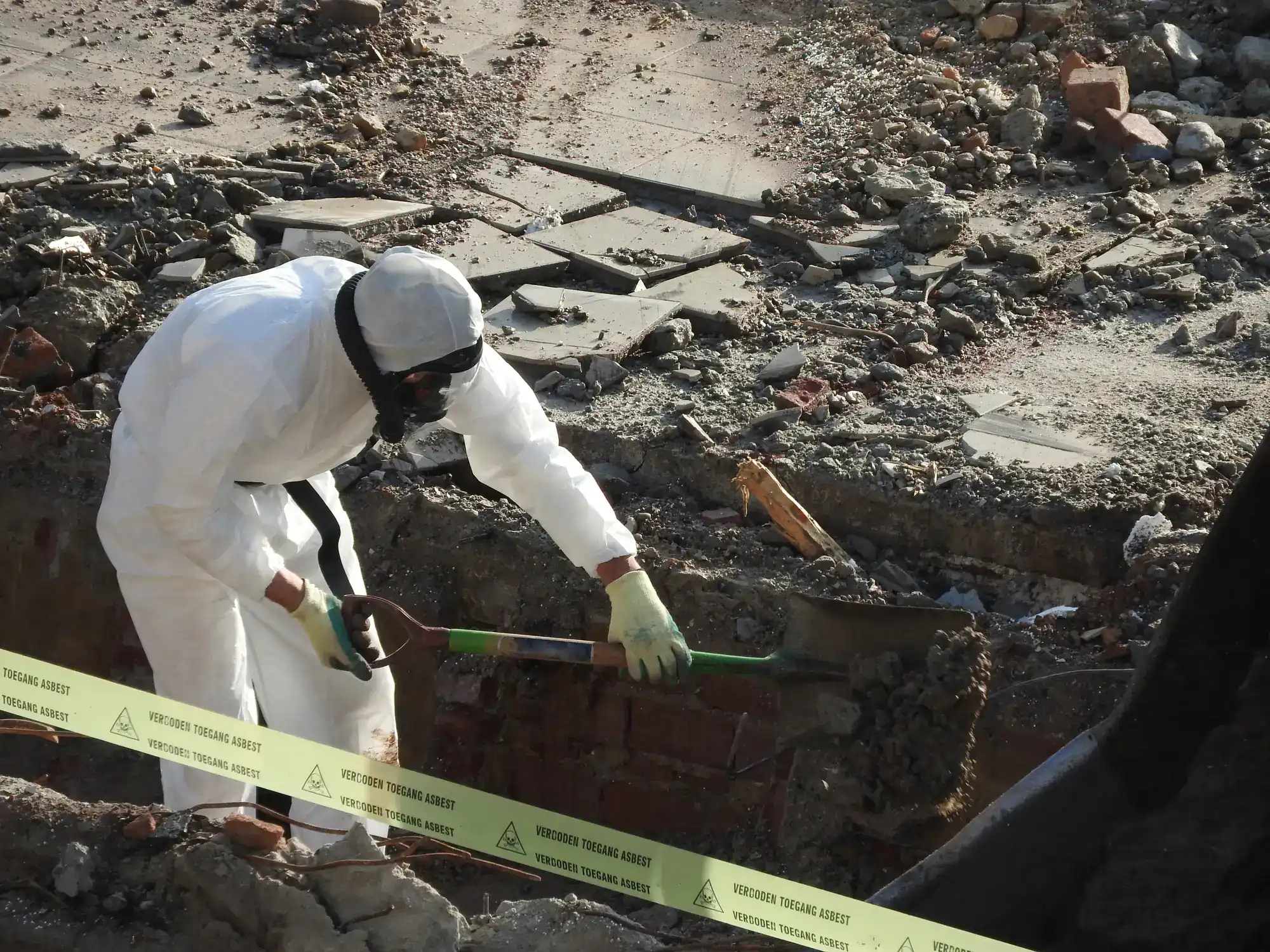
An asbestos survey is a more comprehensive assessment than a single-point inspection. Where a spot inspection tests one suspicious material, a survey evaluates the entire building — systematically identifying every location where asbestos-containing materials may be present. If you’re planning a full renovation, preparing a commercial property for demolition, or buying an older home in Norriton, Ambler, or Lansdale, a full survey is the smarter starting point.
Montgomery County has a unique history here. Ambler was home to the Keasbey & Mattison Company, one of the largest asbestos manufacturers in U.S. history, operating from the 1880s through the mid-20th century. The Ambler Asbestos Piles Superfund site still exists today. Homeowners in and around that borough tend to be more alert to asbestos risks than most — and for good reason.
But it’s not just Ambler. The average home in Montgomery County was built in 1974, which places nearly the entire county’s housing stock squarely within the era when asbestos was used in over 3,000 building products. Floor tiles, ceiling tiles, pipe wrap, roofing shingles, joint compound, siding — if your home was built before 1980, there’s a real chance some of those materials contain asbestos.
A survey gives you a complete picture before work starts, so there are no surprises when the walls come down. It’s also the foundation for any abatement plan, and it’s what certified inspectors use to determine the scope and cost of the project. Skipping it to save a few hundred dollars upfront is one of the more reliable ways to spend thousands more later.
Pennsylvania requires that anyone performing asbestos abatement hold a current certification from the Department of Labor and Industry. That’s not optional, and it’s not just a formality — it’s a legal requirement. The moment an outside contractor is hired to perform any work involving asbestos, the full regulatory framework kicks in. General contractors cannot legally perform asbestos abatement in Pennsylvania, no matter how experienced they are in other trades.
When you’re evaluating certified asbestos removal companies, the first thing to verify is their PA DLI certification. You can look it up. If a contractor is reluctant to provide their license number or gets vague when you ask, that tells you everything you need to know. The second thing to ask about is insurance — not just a verbal confirmation, but an actual certificate of insurance. Liability coverage and bonding matter because if something goes wrong during an abatement project, the homeowner can be left holding the bag if the contractor isn’t properly covered.
Beyond credentials, pay attention to how a contractor handles the estimate. A legitimate asbestos remediation company will do a site visit, assess the materials, explain the containment plan, and give you an itemized written estimate. Anyone who quotes a price over the phone without seeing the property is guessing — and in a field where costs vary significantly based on material type, location, and square footage, guessing isn’t good enough.
We’re fully licensed, bonded, and insured, and we offer free on-site estimates throughout Montgomery County. We also offer cash discounts, which is something most larger outfits won’t. The goal is to make the process as straightforward as possible — not to pad the invoice.
Want live answers?
Connect with a EJS Environmental expert for fast, friendly support.
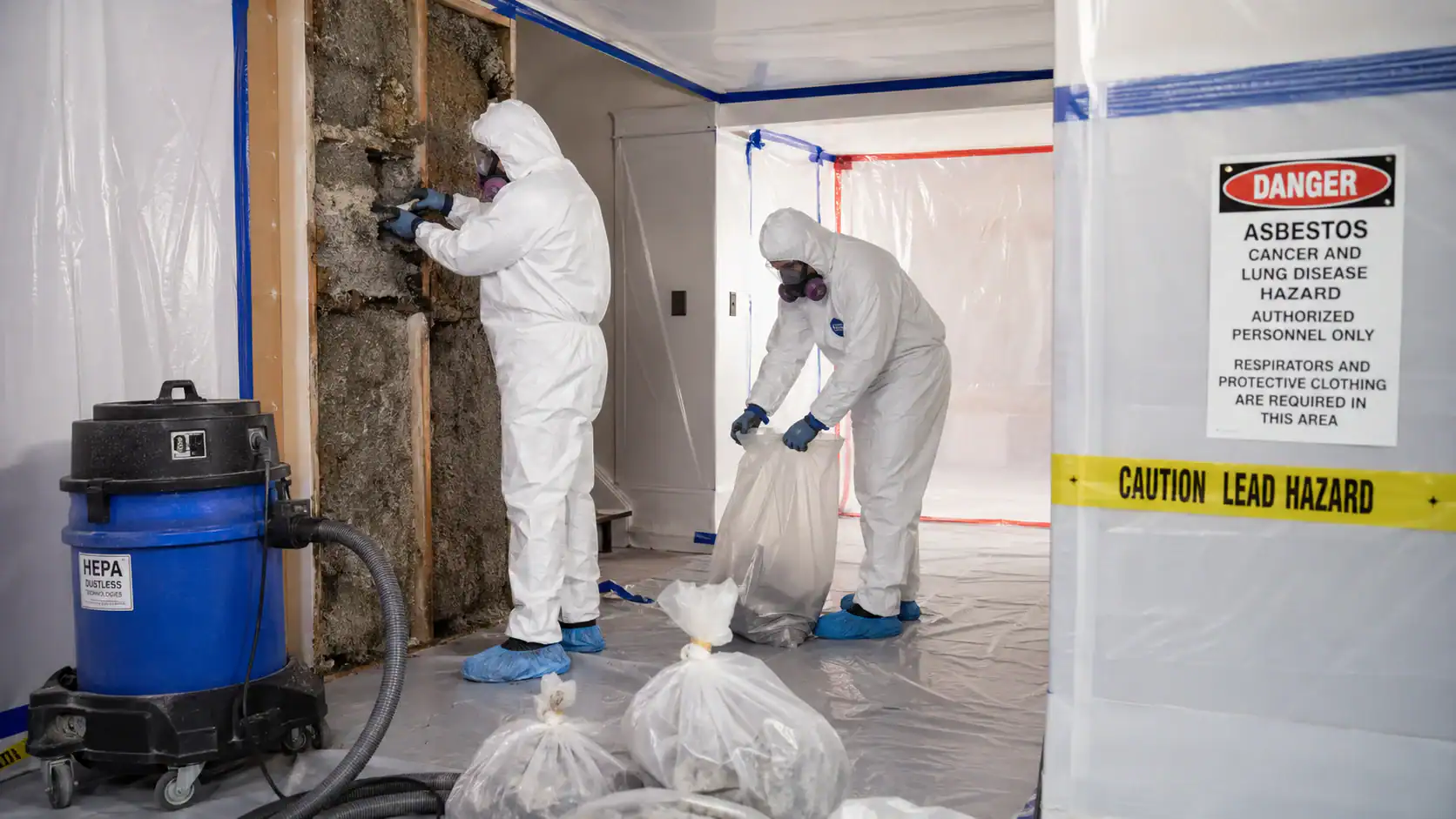
Once inspection confirms the presence of asbestos-containing materials, the abatement process follows a specific sequence. The work area is sealed off with polyethylene sheeting and put under negative air pressure using HEPA-filtered machines — this prevents fibers from migrating to other parts of the building during removal. Workers wear full protective equipment. The materials are carefully wet-wiped to minimize fiber release, removed, bagged, and transported to a licensed disposal facility.
After the work is done, post-abatement air clearance testing is conducted to confirm that fiber levels in the space meet regulatory safety thresholds. That test is the basis for the asbestos removal certificate — the documentation you’ll need for real estate transactions, insurance purposes, or simply your own peace of mind.
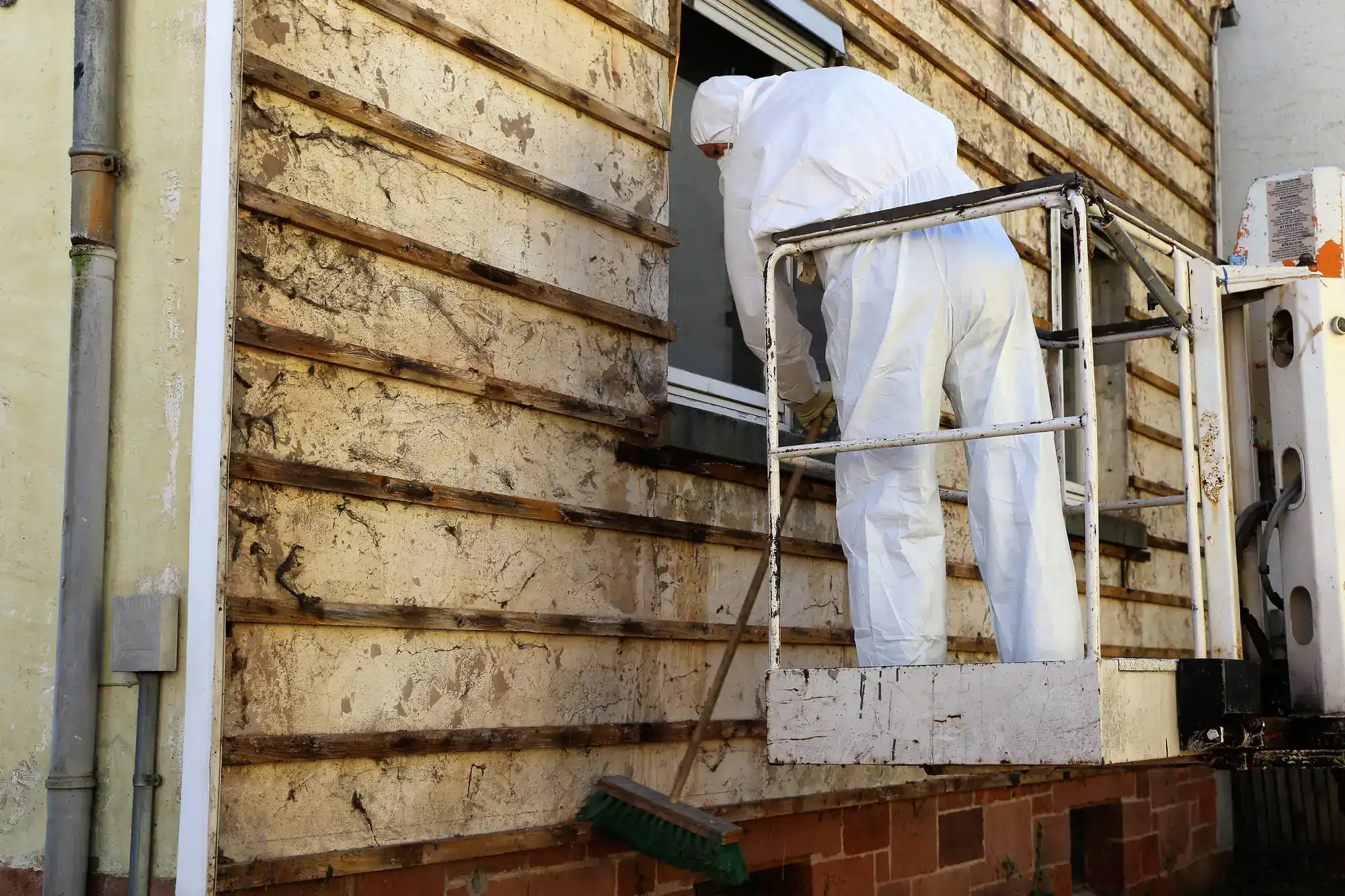
Commercial abatement follows the same core process as residential work but operates at a different scale — and under additional regulatory requirements. Projects that involve more than 260 linear feet, 160 square feet, or 35 cubic feet of friable asbestos-containing material fall under federal NESHAP regulations, which require notification to both PA DEP and the EPA at least 10 working days before work begins. That’s on top of Pennsylvania’s state-level requirements.
Montgomery County has a substantial stock of older commercial buildings — particularly along the Schuylkill River corridor in Norristown, Phoenixville, and Pottstown, where late-19th and early-20th century industrial and mixed-use buildings are common. Many of these properties contain multiple generations of asbestos-containing materials layered on top of each other from different renovation eras.
Schools are another significant category. Montgomery County’s public school buildings from the 1950s through the 1970s are subject to the federal Asbestos Hazard Emergency Response Act, known as AHERA, which mandates ongoing inspection and management of asbestos-containing materials. That creates a consistent institutional demand for licensed abatement services that goes well beyond standard residential work.
Whether the project is a commercial gut renovation in King of Prussia or a school building inspection in Lansdale, the same principles apply: proper containment, licensed workers, documented disposal, and post-abatement clearance testing. We handle both residential and commercial projects across Montgomery County and the surrounding five counties.
For most homeowners in Montgomery County, asbestos becomes an issue in one of three situations: a planned renovation that uncovers suspicious materials, a pre-sale inspection that flags something, or storm or fire damage to a pre-1980 structure. Each scenario carries its own urgency, but the underlying challenge is the same — you need the work done correctly, documented properly, and completed without turning your renovation timeline into a months-long ordeal.
The Main Line is a good example of the residential challenge. Communities like Bryn Mawr, Wayne, Berwyn, and Ardmore have a strong culture of renovating historic Victorian and Colonial Revival homes. These are beautiful properties — and many of them contain multiple layers of asbestos-containing materials that accumulated across decades of updates. A kitchen renovation in a 1920s Wayne colonial isn’t just a construction project. It’s a hazmat coordination exercise if you don’t have the right contractor from the start.
This is where the one-stop model makes a real difference. When asbestos is discovered mid-project, the typical cascade looks like this: the general contractor stops work, the homeowner scrambles to find a separate inspector, then a separate abatement contractor, then figures out disposal, then waits for clearance testing before the GC can return. Every handoff is a delay. Every delay costs money — especially if you’ve already moved out or taken out a construction loan.
We handle the entire process — inspection, abatement, disposal, and clearance testing — under one roof. One call, one schedule, one invoice.
Montgomery County’s official guidance is straightforward: asbestos-containing materials should be removed only by a licensed contractor. That guidance exists for good reason. With a median home age of 1974 and nearly 17% of the county’s housing stock predating 1940, the risk isn’t theoretical — it’s built into the walls of most homes in this area.
The right contractor holds a current PA DLI certification, carries full liability insurance, uses HEPA-grade containment equipment, and provides post-abatement air clearance documentation. They give you a written estimate before any work starts, they answer the phone when you call, and they don’t disappear after the job is done.
If you’re dealing with an asbestos issue in Montgomery County — whether it’s a renovation discovery, a pre-sale requirement, or an emergency situation — we’re available 24/7 and offer free on-site estimates. Two decades serving this county means we’ve seen it all, and we know how to handle it without making your situation harder than it already is.
—
**FAQs**
**What are the health effects of asbestos exposure?** Asbestos exposure is classified by the International Agency for Research on Cancer as a known human carcinogen. It causes mesothelioma — a cancer of the lung lining with a latency period of 30 years or more — as well as lung cancer, laryngeal cancer, ovarian cancer, and asbestosis, a progressive scarring of lung tissue. The fibers are too small to see and too light to feel, which is what makes undisclosed exposure so dangerous. The risk doesn’t diminish over time after exposure. It’s lifelong.
**How much does asbestos abatement cost in Pennsylvania?** The national average sits around $2,245, with most projects falling between $1,215 and $3,280. Interior removal typically runs $5 to $20 per square foot; exterior work — siding, roofing — costs significantly more, often $50 to $150 per square foot. In Montgomery County specifically, costs vary based on the age of the home, the type of material involved, and the accessibility of the work area. Homes along the Schuylkill corridor in Norristown or Pottstown often involve older materials in tighter spaces, which affects both scope and price. The best way to get an accurate number is a free on-site estimate — not a phone quote.
**How much does it cost to remove asbestos floor tiles?** Asbestos tile removal typically runs $5 to $15 per square foot. One thing to know: the black mastic adhesive used to install those tiles often contains asbestos too, so it may need to be tested and removed separately. That can affect the overall cost. If you’re dealing with original mid-century tile in a Montgomery County home — the kind that was standard in homes built through the 1960s and early 1970s — plan for both the tile and the adhesive to be assessed before work begins.
**How do I get an asbestos removal estimate?** Call a licensed contractor and schedule an on-site visit. Any estimate given without a site visit isn’t an estimate — it’s a guess. During the visit, the contractor should assess the materials, explain the containment plan, and provide a written, itemized breakdown of costs. We offer free estimates across Montgomery County and the surrounding area, and we’re available around the clock — including evenings and weekends, which is often when people discover they have a problem.
**Can asbestos exposure cause a skin rash?** Direct contact with asbestos fibers can cause minor skin irritation, but that’s not the primary concern. The serious health risks come from inhaling fibers, not skin contact. Once inhaled, asbestos fibers lodge in lung tissue and cannot be expelled. The resulting diseases — mesothelioma, lung cancer, asbestosis — develop over decades. If you’ve had potential exposure, the right step is to consult a physician and have the source professionally assessed.
Summary:
Share: