Montgomery County's environmental regulations are layered, local, and easy to get wrong. Here's what property owners actually need to know before starting any remediation project.
If you’ve recently discovered a potential environmental hazard in your Montgomery County home or commercial property, you’re probably not thinking about paperwork. You’re thinking about your family, your tenants, your renovation timeline, or your upcoming real estate closing. The regulations feel like a separate problem to deal with later.
They’re not. In Pennsylvania, the permit and notification requirements for asbestos, lead, and mold work are time-sensitive — and missing a step doesn’t just slow things down, it can stop a project entirely. Here’s what you actually need to know before any work begins.
Pennsylvania’s environmental remediation regulations operate on three levels at once: federal EPA rules, state PA DEP and Department of Labor & Industry requirements, and local municipal building codes. For most property owners in Montgomery County, that layered structure is where the confusion starts.
The good news is that the requirements aren’t arbitrary. Each layer exists for a reason, and once you understand the basic framework, the path forward becomes a lot clearer. The key is knowing which rules apply to your specific project — because not every job triggers the same obligations.
Montgomery County is made up of 62 separate municipalities — boroughs, townships, and one city — each with its own building code enforcement and permit office. That means a renovation project in Lower Merion Township runs through a different local permit process than the same project in Lansdale Borough or Pottstown. The state-level requirements from PA DEP are consistent across the county, but the local layer varies considerably.
For asbestos work specifically, the most important state-level requirement is the advance notification to the PA DEP Air Quality Program. Under federal NESHAP regulations — enforced in Pennsylvania by the DEP — any project that disturbs more than 260 linear feet, 160 square feet, or 35 cubic feet of regulated asbestos-containing material requires written notification to PA DEP at least 10 working days before work begins. That’s two full calendar weeks, minimum, before a single piece of material can be touched.
This is the number one source of project delays we see. A homeowner or contractor discovers asbestos during a renovation, doesn’t know about the 10-day rule, and suddenly a Monday start date becomes a three-week problem. The notification itself isn’t complicated — but it has to be filed correctly, with original signatures, or it gets returned and the clock resets. We handle this filing as a routine first step on every qualifying project, so the countdown starts the moment we’re hired, not the moment you figure out what form to file.
The PA DEP Southeast Regional Office, located in Norriton, handles environmental compliance matters for Montgomery County. For projects involving land disturbance — oil tank removal, excavation — the Montgomery County Conservation District, also in Norriton, reviews Erosion and Sediment control plans under Chapter 102 NPDES requirements. Most property owners don’t know that office exists until a project gets flagged. Knowing it in advance is the difference between a smooth project and an unexpected stop-work order.
Asbestos, lead, and mold are three separate regulatory categories in Pennsylvania, and the compliance requirements for each are meaningfully different. Treating them as interchangeable is a mistake that costs property owners time and money.
Asbestos is the most heavily regulated of the three. Pennsylvania requires separate state certifications for six distinct asbestos occupations: contractor, inspector, management planner, project designer, supervisor, and worker. These are issued by the PA Department of Labor & Industry under the Asbestos Occupations Accreditation and Certification Act. A company can’t simply claim to “handle asbestos” — every person on a job site performing asbestos work needs to hold the appropriate individual certification, and the company itself needs a licensed contractor credential. We hold federal licensing for asbestos abatement, which covers both residential and commercial projects that cross NESHAP thresholds.
Lead paint regulations operate under a parallel but distinct framework. The EPA’s Renovation, Repair and Painting Rule — the RRP Rule — requires contractors disturbing lead-based paint in pre-1978 homes to be EPA-certified. For properties receiving HUD funding or federally assisted financing, the requirements go further: the work must be performed or overseen by a Certified Lead Inspector and a Risk Assessor. These are specific, state-issued credentials that most general contractors don’t hold. We do. That distinction matters if you’re a landlord managing subsidized housing in Norriton, a property manager handling a Section 8 unit in Pottstown, or a buyer using an FHA loan on a Main Line property.
Mold is where the regulatory picture gets interesting — and honestly, a little concerning for consumers. Pennsylvania has no statewide mold remediation licensing law. That means anyone with a van and a dehumidifier can legally call themselves a mold remediation specialist. There’s no state agency verifying their training, their containment procedures, or their disposal practices. In a county where basement flooding along the Schuylkill River and Perkiomen Creek corridors is a recurring seasonal event, that regulatory gap is a real problem. It’s why verifying that your mold contractor is fully licensed, bonded, and insured — through other verifiable credentials — matters more here, not less.
Want live answers?
Connect with a EJS Environmental expert for fast, friendly support.
The compliance requirements exist to protect people — workers, occupants, and future buyers. But they also create real legal exposure for property owners who skip steps, even unintentionally. In Pennsylvania, improper asbestos removal can result in EPA fines, DEP enforcement action, and civil liability that follows the property through future sales.
Working with us doesn’t just get the job done safely. It creates a documented paper trail — DEP notifications, waste manifests, clearance testing reports — that protects you at resale and insulates you from liability if questions arise years down the road.
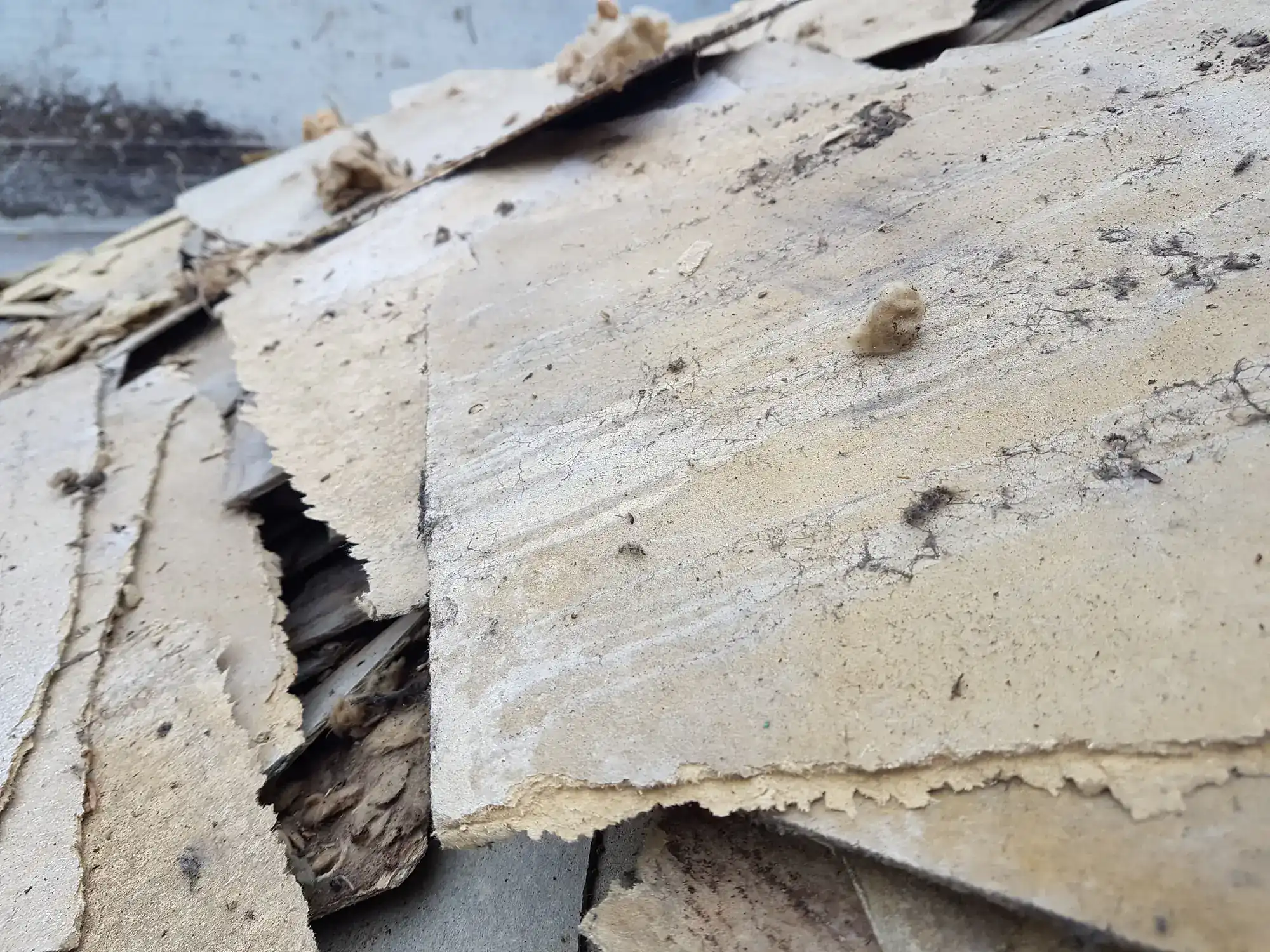
Montgomery County has a large inventory of pre-1980 homes, and in some communities, the concentration of older housing is significant. The Main Line — Lower Merion, Narberth, Haverford, Wayne, Bryn Mawr — is full of large homes built in the 1920s through the 1960s. Norriton and Conshohocken have dense blocks of pre-1940 housing stock. Any building constructed before 1980 should be presumed to potentially contain asbestos-containing materials until tested. Asbestos was used in as many as 3,000 different building components — floor tiles, ceiling tiles, pipe insulation, joint compound, roofing shingles, and more. It wasn’t just industrial buildings.
Ambler, PA, deserves a specific mention here. The borough was home to the Keasbey & Mattison Company, one of the largest asbestos manufacturers in the country, which operated there for decades. The legacy of that history extends beyond the factory itself — Ambler has a documented record of asbestos contamination in soil and building materials throughout the community. If you own property in or near Ambler, the risk profile is elevated, and the case for professional testing before any disturbance work is especially strong.
For lead paint, the cutoff is 1978, not 1980. Any home built before that year may contain lead-based paint, and any renovation work that disturbs painted surfaces — even something as routine as sanding a windowsill — triggers RRP Rule obligations if a contractor is involved. For families with young children, the stakes are higher still: lead exposure at low levels causes developmental effects that don’t always show up immediately.
The pattern across all three hazards — asbestos, lead, and mold — is the same. The older the building, the higher the probability of a hazard. The more work being done, the higher the probability of disturbance. And the higher the disturbance risk, the more important it is to have someone on-site who knows exactly which regulations apply and how to document the work correctly.
**What permits do I need for environmental remediation in Montgomery County, PA?**
It depends on the scope and type of work. For asbestos projects that exceed the NESHAP thresholds, you need a 10-working-day advance notification filed with PA DEP before work begins. That’s the state-level requirement. On top of that, your local municipality may require a building permit for the renovation work itself. In Montgomery County, that means checking with your specific township or borough — not a county-wide office. We handle the DEP notification side and can help you understand what your local municipality requires based on where your property is located.
**How long does the permit process take for asbestos work in Pennsylvania?**
The NESHAP notification is not an approval process — it’s an advance notice. You file it, wait 10 working days, and the project can proceed. The clock doesn’t stop while DEP reviews it. What does slow things down is filing it late, filing it incorrectly, or not knowing you needed to file it at all. For properties throughout Montgomery County — whether in Norriton, King of Prussia, Lansdale, or anywhere else — we file this notification as a standard first step so your timeline doesn’t get derailed by paperwork.
**Does Pennsylvania require a license for mold remediation?**
No — and that’s the problem. Pennsylvania has no statewide mold remediation licensing law, which means the barrier to entry in this field is essentially zero. Anyone can market themselves as a mold remediation contractor without holding any specific credential. That’s why it’s important to look beyond the mold claim and verify that your contractor is fully licensed for the environmental work they do perform under state regulation, fully bonded, and carries proper insurance. In Montgomery County, where basement flooding is a recurring issue — particularly in communities along the Schuylkill River and Perkiomen Creek — that verification step matters.
**What happens if asbestos is removed without the required notification?**
The consequences range from project shutdown to significant fines. EPA and PA DEP have enforcement authority under NESHAP, and violations are taken seriously. Beyond the regulatory penalties, improper asbestos removal — without proper containment, wet methods, HEPA filtration, and licensed waste disposal — can permanently contaminate a property and create liability that follows it through every future sale. The notification requirement isn’t bureaucratic overhead. It’s the mechanism that keeps the project legal and the property owner protected.
**Can I remove asbestos from my own home myself in Pennsylvania?**
Technically, Pennsylvania does not regulate asbestos removal from private single-family residences when the homeowner performs the work themselves. But the moment you hire a contractor, that contractor must be certified and follow all applicable state and federal regulations. More practically: DIY asbestos removal without proper containment, disposal procedures, and air clearance testing carries real health and legal risk. The cost of doing it wrong — contaminating living spaces, creating a disclosure liability at resale, or exposing family members — consistently outweighs the cost of having it done correctly.
Navigating environmental regulations in Montgomery County means dealing with federal rules, state certification requirements, DEP notification timelines, and 62 different municipal permit offices — often simultaneously, often under time pressure. Most property owners don’t have the bandwidth to learn all of it on the fly while also managing a renovation, a real estate transaction, or a water damage situation.
That’s exactly the kind of problem that 20 years of local experience is built to solve. When you work with us, the regulatory layer stops being an obstacle and starts being a manageable part of the project timeline. We already know the DEP filing process, the local municipal requirements, and what proper containment and clearance documentation looks like.
If you’re dealing with asbestos, lead, mold, or any other environmental hazard in Montgomery County, we offer free estimates and 24/7 availability — so you can get real answers without waiting until Monday morning to find out where you stand.
Summary:
Article details:
Share: